Fitness & Metabolic Science
Why is it Important to Know Your TDEE? The Master Key to Health & Body Composition
Understand your Total Daily Energy Expenditure to eliminate dietary guesswork, prevent metabolic burnout, and achieve sustainable fitness results.
Whether your goal is to shed body fat, build lean muscle tissue, boost energy levels, or simply maintain your current weight as you age, you have undoubtedly encountered advice about "calories in versus calories out." Yet, millions of individuals struggle with dieting because they lack a precise starting point for their daily energy budget.
At the core of human nutritional science is a single, fundamental metric known as TDEE—Total Daily Energy Expenditure.
Understanding your TDEE is not just for competitive bodybuilders or professional athletes. It is the single most critical piece of physiological data anyone can possess when attempting to modify their body composition or optimize their energy levels.
1. Deconstructing TDEE: The Four Components of Metabolism
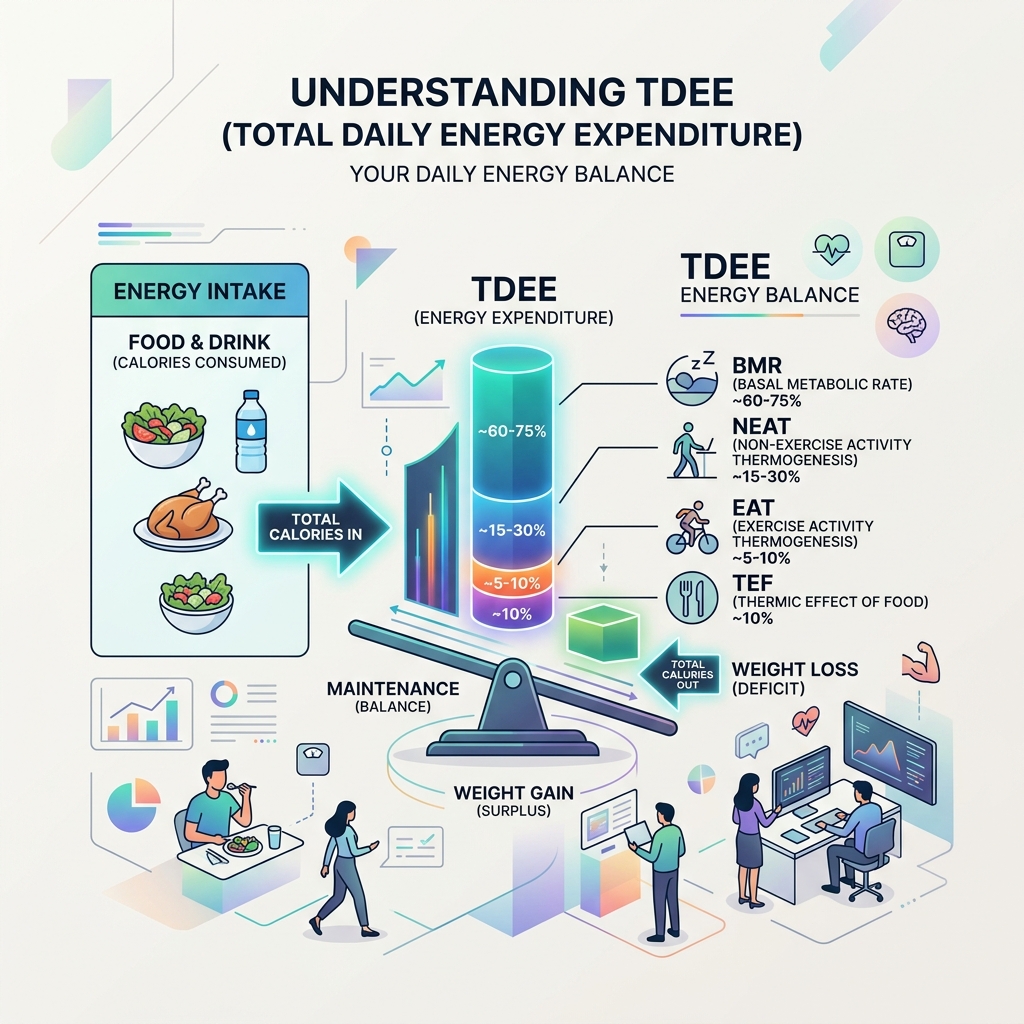
Your Total Daily Energy Expenditure is the total number of calories (kilocalories) your body burns over a 24-hour period. Rather than being a single static engine, human metabolism is composed of four distinct energy output streams:
🫀 Basal Metabolic Rate (BMR)
60% – 70% of TDEE
The baseline energy your body requires simply to stay alive in a rested state—powering brain function, heart contractions, cellular repair, and organ maintenance.
🚶 Non-Exercise Activity (NEAT)
15% – 20% of TDEE
Calories burned through non-deliberate daily physical movement: walking to your car, typing at a desk, taking stairs, posture adjustments, and fidgeting.
🥗 Thermic Effect of Food (TEF)
~10% of TDEE
The chemical energy required to digest, absorb, and process nutrients. Protein requires the highest digestive energy (~20-30% of its calories).
🏋️ Exercise Thermogenesis (EAT)
5% – 15% of TDEE
Calories expended during structured, intentional physical exercise such as weightlifting, running, swimming, or high-intensity interval training.
2. The Science of Estimating BMR: Mifflin-St Jeor Formula
To calculate your TDEE, scientists first estimate your Basal Metabolic Rate using validated clinical equations.
The Mifflin-St Jeor Equation is widely considered by dietitians to be the most accurate predictive formula for BMR in healthy adults:
For Men:
BMR = (10 × weight in kg) + (6.25 × height in cm) - (5 × age in yrs) + 5
For Women:
BMR = (10 × weight in kg) + (6.25 × height in cm) - (5 × age in yrs) - 161
Once your BMR is determined, it is multiplied by an Activity Factor (ranging from 1.2 for sedentary individuals to 1.9 for extreme athletes) to compute your final TDEE.
3. Why Generic "2,000 Calorie" Rules Fail
Standard nutritional labels on food products reference a "daily diet of 2,000 calories." However, using 2,000 calories as a universal goal ignores individual human variance:
- A 6'2" male construction worker who exercises daily may have a TDEE of 3,200 calories. Eating 2,000 calories would represent a severe crash diet.
- A 5'2" female desk worker who leads a sedentary lifestyle may have a TDEE of 1,550 calories. Eating 2,000 calories daily would result in gradual weight gain over time!
4. How to Apply Your TDEE to Specific Health Goals
📉 For Sustainable Fat Loss (Moderate Deficit)
Consume 300 to 500 calories below your TDEE daily. This creates a caloric deficit of 2,100 to 3,500 calories per week, resulting in roughly 0.5 to 1.0 lb of healthy fat loss per week without causing muscle wasting or hormonal fatigue.
💪 For Lean Muscle Growth (Controlled Surplus)
Consume 200 to 300 calories above your TDEE daily alongside progressive resistance training. This supplies the necessary amino acids and energy for muscle synthesis while minimizing unwanted fat storage.
⚖️ For Maintenance & Performance
Consume equal to your TDEE. This maintains your current body weight, optimizes recovery, and supports consistent athletic performance.
5. Calculate Your Baseline TDEE with DayLogic
Stop relying on guesswork or unsustainable fad diets. Knowing your exact TDEE gives you scientific control over your health journey.
Visit DayLogic’s Fitness & Health Suite to calculate your exact BMR, TDEE, and macronutrient targets in seconds.
Calculate Your Exact TDEE Now
Get personalized BMR, TDEE, and daily macro recommendations tailored to your age, height, weight, and activity level.