The True Cost of Borrowing: How Loan Amortization and Interest Schedules Actually Work
Why equal monthly mortgage payments hide a front-loaded interest trap, and how simple mathematical acceleration strategies save you tens of thousands in interest.
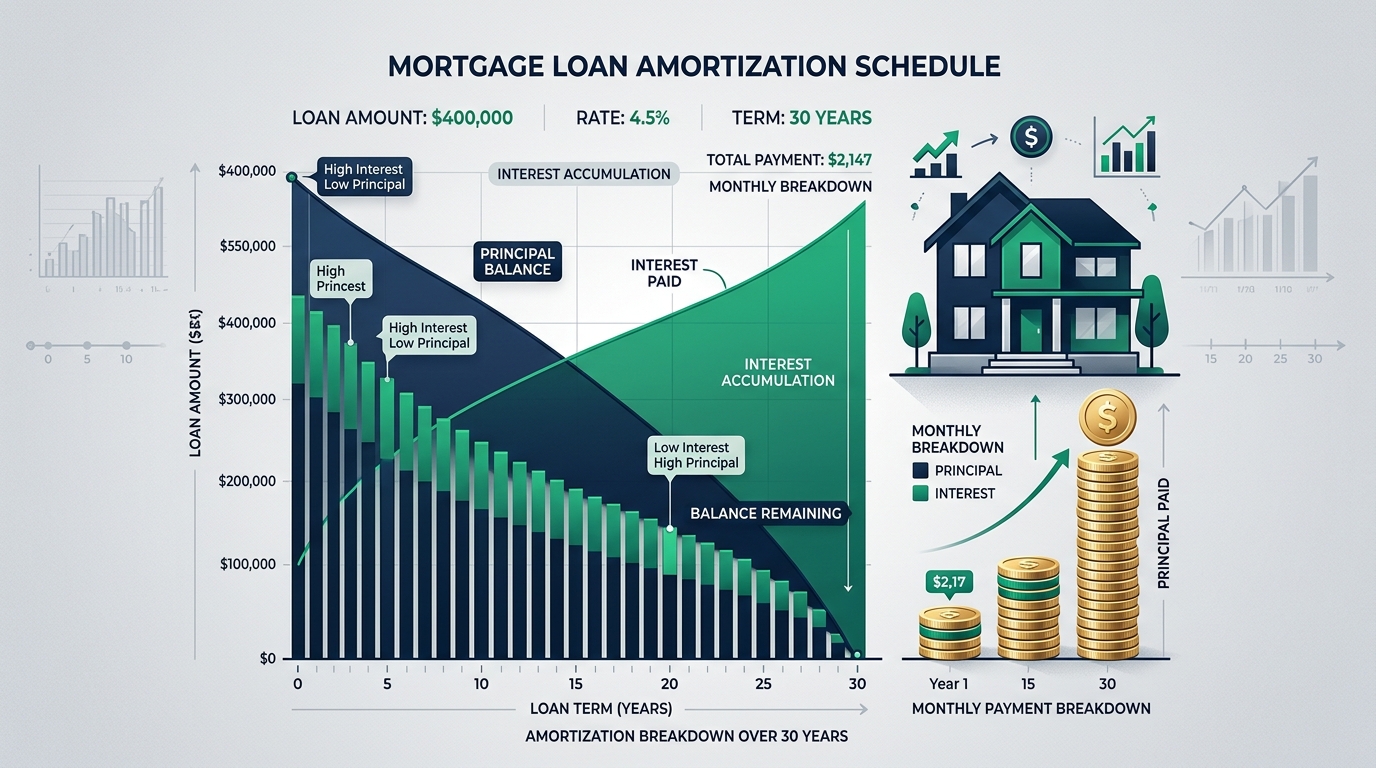
Visualizing the shifting ratio of interest versus principal over a 30-year fixed loan amortization curve.
Taking out a mortgage or large term loan is often the single biggest financial transaction of a person's life. When your loan officer sends over closing documents with a smooth, predictable number—say, "$2,147.29 per month for 360 months"—it feels straightforward and manageable.
You make your payments faithfully every month for five full years. You have sent the bank over $128,800 in cash. Naturally, you expect your loan balance to have decreased by a similar amount.
Then you log into your lending portal to check your balance, and shock sets in: your original $400,000 mortgage has only dropped to $372,000.
Where did the other $100,000+ go?
The answer lies in the mechanics of Loan Amortization. In this guide, we will pull back the curtain on how lenders calculate your monthly interest, explain the mathematical tipping point, and show you actionable mathematical hacks to shave years off your debt.
1. What Does "Amortization" Actually Mean?
The word amortize comes from the Old French amortir and Latin ad-mort, which literally translates to "to bring to death."In financial mathematics, amortization is simply the systematic process of "killing off" a debt over time through scheduled, regular installments.
With standard installment loans (such as fixed-rate mortgages, auto loans, and student loans), every monthly payment you make is split into two distinct parts:
Interest Payment
The fee paid directly to the lender for the privilege of borrowing money. This builds zero equity.
Principal Reduction
The portion that actually pays down your original borrowed balance, increasing your home equity.
2. The Front-Loaded Interest Mechanism Explained
Why do early payments go almost exclusively to interest? Because interest is calculated monthly based on your remaining outstanding balance.
Consider a $400,000 mortgage at 5.0% annual interest on a 30-year fixed term:
Month 1 Calculation:
- • Total Monthly Payment (P&I): $2,147.29
- • Month 1 Interest Fee = $400,000 × (0.05 / 12) = $1,666.67 (77.6% of payment!)
- • Month 1 Principal Reduction = $2,147.29 − $1,666.67 = $480.62 (22.4% of payment)
- • New Balance Starting Month 2: $399,519.38
In Month 2, interest is recalculated against $399,519.38. Because the principal is slightly lower, the monthly interest charge decreases by just $2.00, allowing $2.00 more to go toward principal.
3. Lifecycle of a 30-Year Amortization Schedule ($400,000 @ 5%)
| Milestone | Monthly Payment | Interest Split | Principal Split | Remaining Loan Balance |
|---|---|---|---|---|
| Month 1 (Year 1) | $2,147.29 | $1,666.67 (77.6%) | $480.62 (22.4%) | $399,519 |
| Month 60 (Year 5) | $2,147.29 | $1,550.80 (72.2%) | $596.49 (27.8%) | $371,595 |
| Month 120 (Year 10) | $2,147.29 | $1,353.94 (63.0%) | $793.35 (37.0%) | $324,146 |
| Month 186 (Year 15.5) 🎯 | $2,147.29 | $1,073.00 (50.0%) | $1,074.29 (50.0%) | $257,520 |
| Month 240 (Year 20) | $2,147.29 | $780.89 (36.4%) | $1,366.40 (63.6%) | $186,047 |
| Month 360 (Year 30) | $2,147.29 | $8.91 (0.4%) | $2,138.38 (99.6%) | $0.00 |
Notice that the Tipping Point (where more than 50% of your payment finally goes toward your own principal) does not occur until Year 16 (Month 186)!
4. 15-Year vs. 30-Year Mortgages: The Math of Total Interest
Borrowers are frequently tempted by 30-year terms because the lower monthly payment feels easier on the budget. However, examine the profound lifetime difference:
🏠 30-Year Fixed ($400,000 @ 5%)
- • Monthly Payment: $2,147.29
- • Total Amount Paid: $773,023
- • Total Interest Paid: $373,023
- • You pay almost double the original home purchase price!
⚡ 15-Year Fixed ($400,000 @ 4.5%)
- • Monthly Payment: $3,059.95 (+$912/mo)
- • Total Amount Paid: $550,791
- • Total Interest Paid: $150,791
- • Net Lifetime Savings: $222,232 in pure cash!
5. Acceleration Hacks: The Power of the "13th Payment"
What if you cannot commit to the higher monthly obligation of a 15-year loan, but still want to avoid paying hundreds of thousands in unnecessary interest?
You can utilize mathematical acceleration strategies while keeping the safety buffer of your 30-year fixed note:
🚀 Strategy A: The "13th Payment" (Bi-Weekly Schedule)
Instead of paying once per month (12 payments/year), pay half your mortgage every two weeks (26 half-payments = 13 full monthly payments/year). That single extra annual payment applies 100% directly to your principal. On a $400,000 30-year loan at 5%, this single trick shaves nearly 5 years off your mortgage and saves over $60,000 in interest!
💰 Strategy B: The Round-Up Method
If your payment is $2,147.29, round your monthly check up to an even $2,300 (an extra $152.71/month). Because extra principal payments compound in reverse over decades, this simple consistency trims 3.5 years off your debt horizon.
⚠️ Crucial Lender Note: Specify "Principal-Only"
When sending extra payments, always explicitly instruct your loan servicer to apply the funds as "Principal-Only Reduction" rather than prepaying future monthly interest statements.
6. Model Your Amortization Schedule with DayLogic
Before signing loan paperwork or deciding how much extra principal to pay toward your mortgage each month, run the exact numbers through a transparent financial calculator.
DayLogic’s Finance Suite provides interactive Loan Amortization and Compound Growth Calculators. Test custom loan amounts, interest rates, terms, and extra payment schedules to see your exact interest savings in seconds.
Calculate Your Loan Amortization
See your month-by-month principal balance, interest split, and early payoff savings with DayLogic Finance Tools.
Launch Loan & Finance Tools