Every time you glance at a calendar on your wall, schedule a dentist appointment, or calculate the exact number of days between two dates, you are interacting with a masterpiece of ancient astronomical engineering. Yet, the 365-day Gregorian calendar we take for granted today is not a natural law—it is the result of thousands of years of mathematical compromises, political maneuvering, and astronomical corrections.
Long before wristwatches or smartphone screens existed, early human civilizations looked to the heavens for guidance. Agriculture required knowing when to plant and harvest; religion required tracking sacred festivals; and governance required coordinating trade. To structure their lives, humanity developed two fundamental calendar systems: Lunar and Solar.
1. The Lunar Impulse: Reading the Phases of the Night Sky
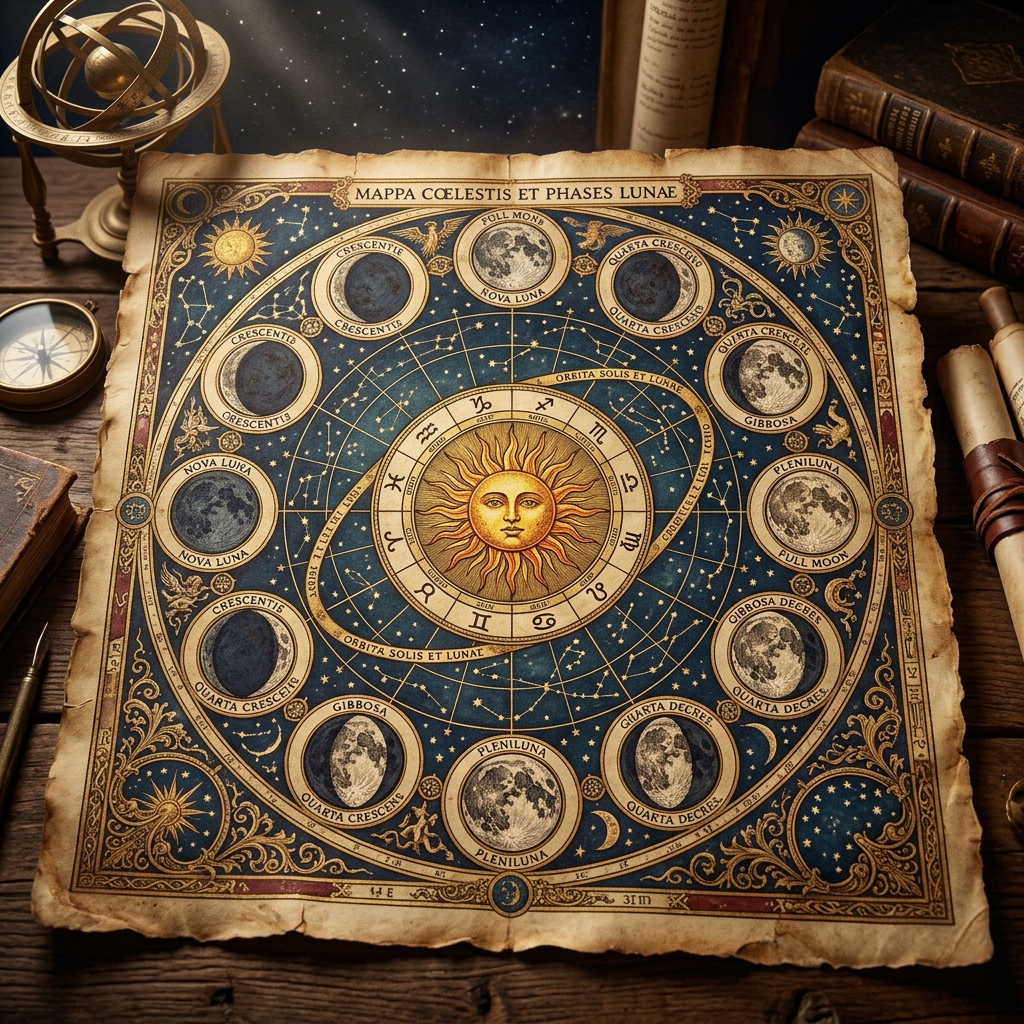
The moon was humanity’s first clock. The lunar cycle—moving from a sliver of a new moon to a glowing full moon and back to darkness—is dramatic, easily observable, and recurs roughly every 29.53 days (known as a synodic month).
For early nomadic societies and hunter-gatherers, a 12-month lunar calendar (totaling approximately 354 days) was instinctive. However, this system suffered from a major astronomical flaw: The Lunar Drift.
**The Mathematics of Lunar Drift** Because a 12-month lunar year is ~354 days long, it falls short of the true solar year (~365.2422 days) by roughly 11 days every year. Over 33 years, a purely lunar calendar drifts through all four natural seasons.
The Islamic calendar (Hijri) remains the primary purely lunar calendar used worldwide today. Because it does not adjust for the solar year, holy periods like Ramadan rotate backward through the solar seasons over a 33-year cycle—occurring in hot summer months during one decade and cool winter months three decades later.
2. Lunisolar Calendars: Harmonizing Moon and Seasons
For agrarian societies reliant on annual flooding and harvest cycles, a calendar that drifted away from the seasons was problematic. Farmers could not afford to plant crops in the middle of winter just because the calendar marked the "harvest month."
To solve this, ancient astronomers in Mesopotamia, China, and Judea developed Lunisolar Calendars. These systems kept months aligned with moon phases while periodically inserting a 13th "leap month" (an intercalary month) every two to three years to resynchronize the calendar with the solar equinox.
By the 5th century BCE, the Greek astronomer Meton discovered the Metonic Cycle: 19 solar years are almost exactly equal to 235 lunar months. By inserting 7 leap months over every 19-year period, lunisolar calendars—such as the Hebrew Calendar and traditional Chinese Calendar—achieved remarkable accuracy, keeping cultural traditions linked with celestial rhythms.
3. The Solar Revolution & Roman Calendar Chaos
The ancient Egyptians were among the first to abandon the moon entirely in favor of a purely solar calendar. Observing that the annual flooding of the Nile aligned perfectly with the heliacal rising of the star Sirius, Egyptian astronomers created a 365-day solar calendar composed of 12 months of 30 days plus 5 extra festival days.
Meanwhile, early Rome suffered under a notoriously chaotic calendar system. Originally a 10-month lunar calendar attributed to Romulus (which is why September, October, November, and December originate from the Latin words for 7, 8, 9, and 10), it was repeatedly manipulated by politicians (the Pontifex Maximus), who would artificially lengthen or shorten months to extend their terms in office or collect taxes earlier.
The Year of Confusion (46 BCE)
By 46 BCE, political tampering had left the Roman calendar nearly three months out of sync with the natural seasons. To fix this, Julius Caesar enacted a massive reform, forcing the year 46 BCE to last an unprecedented 445 days—earning it the historical moniker Annus Confusionis ("The Year of Confusion").
4. The Julian Leap: Caesar’s 365.25-Day Model
Guided by the Alexandrian astronomer Sosigenes, Julius Caesar introduced the Julian Calendar in 45 BCE. Sosigenes recognized that the solar year was approximately 365.25 days long.
To account for that fractional quarter-day (0.25), the Julian calendar established a simple, elegant rule: every four years, an extra day—a leap day—would be added to February.
For over 1,600 years, the Julian calendar governed Europe. However,Sosigenes' calculation contained a subtle mathematical error.
5. The Gregorian Reform of 1582: Correcting 11 Minutes
The actual astronomical solar year (tropical year) is not 365.25 days—it is approximately 365.24219 days. Sosigenes had over-estimated the length of the solar year by roughly 11 minutes and 14 seconds per year.
While 11 minutes sounds trivial, over a millennium, those missing minutes compounded into a full day every 128 years. By the 16th century, the spring equinox had drifted from March 21 back to March 11. This created a crisis for the Catholic Church, which relied on the spring equinox to calculate the date of Easter.
In 1582, Pope Gregory XIII, working with Italian physician Aloysius Lilius and mathematician Christopher Clavius, issued the papal bull Inter gravissimas, instituting the Gregorian Calendar.
The Modern Gregorian Leap Year Algorithm
To eliminate the 11-minute drift, Gregory XIII refined the leap year rule:
- ✅ A year IS a leap year if it is evenly divisible by 4.
- ❌ EXCEPT if it is divisible by 100, it is NOT a leap year...
- ✅ UNLESS it is also evenly divisible by 400 (e.g., 2000 was a leap year, but 1900 and 2100 are not!).
To restore alignment immediately, Pope Gregory XIII ordered that Thursday, October 4, 1582, be followed directly by Friday, October 15, 1582—wiping 10 days out of existence.
6. Why Calendar Math Matters Today
Modern civilization relies on global synchronization. Whether managing global supply chains, calculating international financial loan tenures, or scheduling international satellite orbits, exact day counts across leap years and century boundaries are vital.
Calculating these dates mentally across uneven month lengths (28, 30, 31 days) and leap rules remains notoriously prone to human error. That is why modern tools like DayLogic’s Date Calculator automate these historical and mathematical nuances, giving you exact day differences instantly.
Calculate Date Spans Instantly
Need to find the precise number of days between two historical or future dates? Try DayLogic’s free Date Calculator.